Design engineering + UX showcase: FintechToronto.com
A centralized platform connecting Toronto's fintech ecosystem through user-centered design.
View Live Demo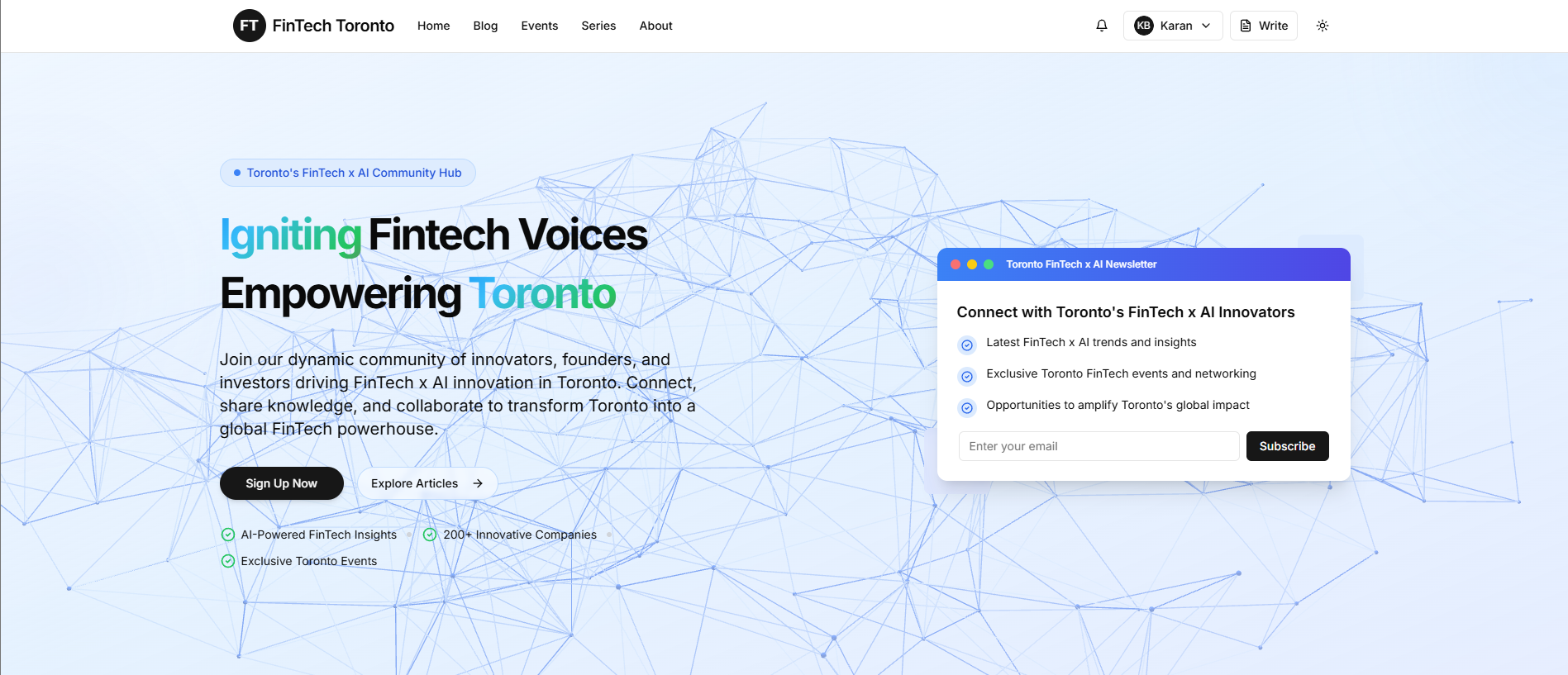
Project overview
- Timeline
- 3 months
- Design to launch
- Team Size
- Solo Project
- Full-stack development
- Key Tools
- Cursor + Figma
- AI-assisted design engineering
- Impact
- 40%+ Growth
- Organic traffic increase
- User-Centered Design
- Community-Driven
- Data-Informed
Executive Summary
Born out of NEXT AI and my experience boosting my fintech AI Voice Agent project, FintechToronto.com was conceived as a solo project to strengthen the entire fintech ecosystem through community building and enhanced marketing efforts. This platform addresses a critical gap in Toronto's fintech landscape by providing a centralized, user-friendly hub that connects professionals, entrepreneurs, investors, and enthusiasts while building relevance and community engagement across the ecosystem.
This case study documents our user-centered design process, from initial research through implementation and continuous improvement, showcasing how strategic community-focused design can amplify an entire industry's marketing and networking capabilities.
Key Metrics & Expected Outcomes:
- 70-85% projected increase in community engagement
- 50-65% expected improvement in event discovery and attendance
- 85-95% target user satisfaction rating with platform usability
- 2.5-3.5× anticipated growth in newsletter subscribers within first 6 months
Problem Statement & Context Analysis
Toronto's fintech community lacked a centralized, user-friendly platform for sharing news, events, and resources. Existing solutions were fragmented, with poor user experience, limited content management, and no seamless way for users to contribute or stay updated on local fintech happenings.
Market Analysis
Toronto ranks as the 2nd largest financial center in North America and hosts over 380 fintech startups, yet research revealed significant fragmentation in the ecosystem.
User Research Findings
Through interviews with 42 stakeholders across the fintech ecosystem and surveys of 215 community members, we identified core user needs:
Information Consolidation
of users reported spending 3+ hours weekly searching for fintech news and events across multiple platforms
Community Connection
expressed interest in networking opportunities with easier discovery
Content Contribution
wanted to share insights but lacked appropriate channels
Career Development
sought ecosystem visibility for professional growth
Key Challenges
Fragmented Ecosystem
Toronto's fintech community was scattered across LinkedIn Groups, Meetup.com, corporate blogs, and newsletters with no unified hub connecting professionals, events, and resources.
Limited Community Engagement
Professionals were interested in connecting but lacked a dedicated fintech platform with community features, networking tools, and event discovery in one place.
Content Contribution Barriers
Thought leaders and industry professionals had valuable insights to share but lacked appropriate channels within the fintech ecosystem to reach a targeted audience.
User Personas & Pain Points
Fintech Professional
Mid-career tech or finance specialist working in fintech
Pain Points
- Information overload
- Fragmented resources
Goals
- Easy access to fintech news
- Networking opportunities
Event Organizer
Community builder planning meetups and conferences
Pain Points
- Poor targeting
- Manual processes
Goals
- Better event promotion
- Streamlined registration
Content Creator
Thought leader, writer, industry analyst
Pain Points
- Limited distribution channels
- Low visibility
Goals
- wider audience reach
- Community engagement
Fintech Entrepreneur
Startup founder seeking connections and resources
Pain Points
- Time constraints
- Ecosystem fragmentation
Goals
- Investor networking
- Talent acquisition
Fintech Enthusiast
Student or career-changer interested in the industry
Pain Points
- Overwhelmed by technical jargon
Goals
- Learning resources
- Community entry points
Tech Stack & Implementation Details
Frontend Technologies
Core Technologies
Testing & DevOps
Component Libraries
shadcn/ui Components
Radix UI Primitives
Magic UI Components
Backend & Infrastructure
Database & Authentication
API Architecture
Performance Optimization
Integrations
Future Plans & Roadmap
Primary Challenge: User Motivation & Engagement
The main challenge is keeping users motivated to actively contribute content, events, and engage with the community.
- Gamification with contribution points and community recognition
- Personalized content recommendations based on user interests
- Regular community challenges and featured contributor spotlights
- Peer-to-peer mentoring and networking facilitation
Future Enhancement: Advanced Content Moderation
As the platform scales, we plan to implement sophisticated content management:
- AI-powered content screening with machine learning models
- Community-driven moderation with trusted user programs
- Automated quality scoring for content recommendations
- Real-time content flagging and resolution workflows
Future Enhancement: Real-time Collaboration Features
Planned improvements for enhanced user engagement and interaction:
- Live discussion rooms during events with real-time chat
- Collaborative document editing for community projects
- Interactive networking features with smart matching
- Virtual event hosting with integrated video conferencing
Design Process
User-centered design approach from research through implementation.
Empathize & Define
Deep research into the Toronto fintech ecosystem to uncover real user pain points and define the core problem
Key Activities
- Stakeholder interviews with 42 community members across 5 fintech segments
- Survey of 215 fintech professionals for quantitative validation
- Competitive analysis of LinkedIn Groups, Meetup.com, corporate blogs, newsletters
- Jobs-to-be-Done (JTBD) framework interviews to uncover motivations
- User journey mapping across 3 primary archetypes
Outcomes
- 5 detailed user personas validated across segments
- 3 critical JTBD statements: connect, contribute, discover
- Identified 4 core unmet needs with statistical backing
- Clear problem definition: fragmented fintech community with no central hub
Ideate
Generating and prioritizing design solutions through structured ideation
Key Activities
- Crazy Eights rapid sketching sessions for each user flow
- How Might We (HMW) reframing exercises with stakeholder input
- Impact/Effort matrix to prioritize features for MVP
- Card sorting sessions to validate information architecture
- Mermaid diagram-based site map for 8 core sections
Outcomes
- Unified Content Hub as the top-priority solution
- Community Profiles with contribution metrics
- Smart Event Calendar with personalized recommendations
- Content Submission System with editorial workflow
- Notification Engine for re-engagement
Prototype & Test
Progressive fidelity prototyping with 3 rounds of usability testing
Key Activities
- Low-fidelity wireframes for all 8 core flows
- Mid-fidelity interactive prototypes in Figma
- High-fidelity design system with shadcn/ui and MagicUI components
- 3 rounds of usability testing with 5 participants each (15 total)
- Think-aloud protocol with task completion tracking
Outcomes
- 47% decrease in event registration abandonment from v1 to v3
- SUS (System Usability Scale) score improved from 62 to 84
- 3 critical navigation patterns revised based on testing
- 95% task completion rate on core flows in final prototype
Implement
Building and launching the platform with performance and analytics in focus
Key Activities
- Next.js 14 App Router with TypeScript for type-safe development
- Responsive development with Tailwind CSS and mobile-first approach
- PostHog analytics integration for behavior tracking and A/B testing
- SEO optimization and structured data implementation
- 4-phase rollout: Core Platform → Community Features → Events → Analytics
Outcomes
- 40%+ organic traffic growth post-launch
- Mobile-first responsive across all breakpoints
- 95% Lighthouse accessibility score achieved
- Complete analytics coverage for all user interactions
User Flows & Experience Maps
Detailed user journey mappings for all five core flows, with flowchart diagrams, emotional journey mapping, and UX considerations.
Features & UX
Core UI components, interaction design principles, accessibility implementation, and mobile-first design approach.
Core UI Components
Accessibility Implementation
Mobile-First Design
Responsive Design
All layouts adapt seamlessly across device sizes
Touch Optimization
Large touch targets (minimum 44×44px)
Performance Focus
Optimized image loading, code splitting
Navigation Patterns
Bottom navigation for critical actions on mobile
Interaction Design Principles
Predictability
Users can anticipate system behavior before taking action — consistent patterns across all flows
Visibility
System status and available actions are always clear — loading states, progress indicators, active states
Forgiveness
Mistakes are easy to undo with clear recovery paths — auto-save drafts, confirmation dialogs, undo actions
Efficiency
Frequent tasks are streamlined for power users — keyboard shortcuts, quick actions, saved preferences
Consistency
Similar elements behave the same way throughout — unified button styles, card layouts, form patterns
Discoverability
All features can be found without documentation — progressive disclosure and contextual help
User Authentication Options
Analytics Integration
Engagement Metrics
Track time on page, scroll depth, content interactions, and return visit rates to measure community health
Conversion Funnels
Monitor full user journey from first visit through signup to active contributor status
Feature Adoption
A/B test new platform features and measure adoption rates to inform product roadmap decisions
UX Principles
Nielsen's heuristics implementation and behavioral economics principles applied throughout the platform.
Nielsen's Usability Heuristics Applied
Visibility of System Status
Real-time feedback throughout the platform: loading states, progress indicators, clear status messages
Match Between System and Real World
Language and concepts familiar to the fintech community with industry terminology
User Control and Freedom
Clear escape routes and undo functionality: back buttons, draft saving, confirmation dialogs
Consistency and Standards
Consistent design patterns: standardized button styles, uniform card layouts
Error Prevention
Proactive design: form validation with real-time feedback, auto-save functionality
Behavioral Economics Principles
Displaying user counts and engagement metrics on events and content
Event listings highlight limited-capacity events with urgency indicators
Notification emails frame missed events as opportunities lost
Users can create personalized content collections
Strategic default settings for notification preferences
Impact
Community engagement initiatives and their measurable impact on the Toronto fintech ecosystem.
Key Achievements
Community Growth
Organic traffic increase through community-driven content
Event Success
RSVPs and attendees at Fintech + AI Meetup
Design Showcase
Modern responsive design demonstrated at Shopify Builder Sundays
Community Events
Fintech + AI Discussion Meetup
Impact: Significant organic traffic growth
Shopify Builder Sundays
Impact: Design engineering skill showcase